Sunday, 10 May 2015

Imperial Festival Day 2

The Imperial Festival has come to a close but day 2 was jam-packed with science! Today Team Laser consisted of myself, Jake Bulmer, a second year (Physics) Undergraduate at Imperial College and the fantastic, Radhwan Alnaimi, a Research Associate of the Plasma Physics Department at Imperial College.

Day 2 was even busier than day 1 and I think about 200 balloons were popped with the laser! It was great to spread science knowledge to all ages and hopefully get people excited about science and maybe, if I was lucky enough, to convince them to take science further in their career/education path.

Here are some highlights of the second day of the Imperial Festival:

POP-O-MATIC

Art work under a Polaroid filter

Artwork with no Polaroid filter

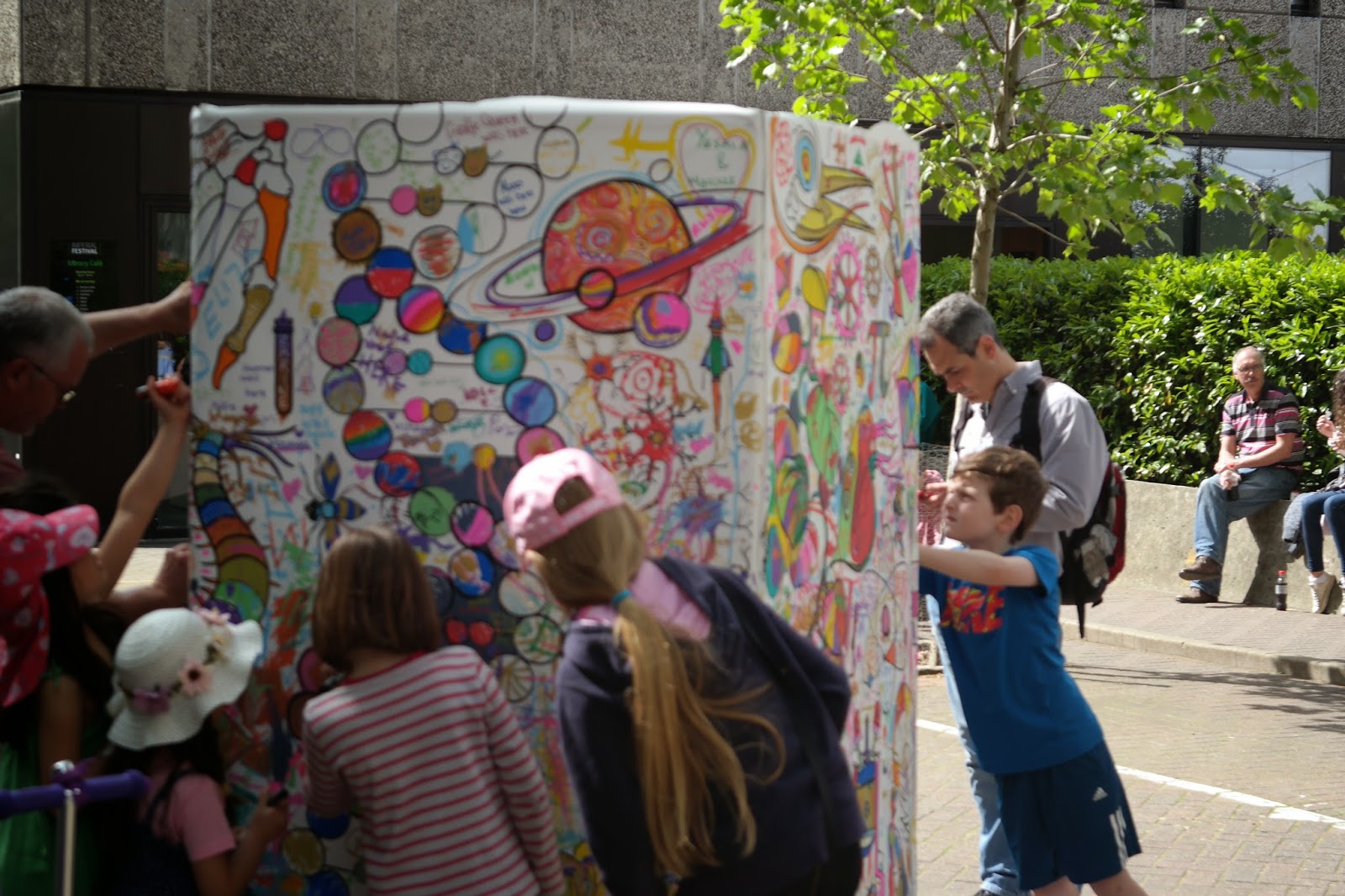
Impfest colour-in wall

St John's Ambulance - First Aid

Bubbles!

Bubbles!


Craters created by meteors - simulation

Fluorescence

Lenses

Lenses


Popping a balloon with a Class 3B laser

Light Zone


The Imperial Festival was a great way for the public to engage with science and scientists - for more Imperial events click here.

Saturday, 9 May 2015

Imperial Festival - Day 1

The Imperial Festival ran from 12 - 6pm today at the South Kensington Campus of Imperial College, I was lucky enough to have been able to show the public the extra cool side of lasers.


Team Laser, including myself and the amazing Tim Robinson, a PhD student of the Plasma Physics Department hosted the stand. We showed the visitors at the Festival how lasers can be totally internally reflected in a fish tank full of sugar and water; how Newton's rings (an interference phenomena that shows the wave nature of light) can form on your phone screen; how lenses can be used to converge and diverge light and the grande finale was using a Class 3B laser to pop a balloon! The balloon popping laser gained a lot of love from the public, particularly the young ones where there were many screams and jumps due to the unexpected nature of the pop!

But what made my day was not only having fun with lasers but being able to act as a female role model for the many young females that visited my stand - I was asked about my education path so far and it was nice to share my story and (hopefully) inspire some of them.

Before some pictures, let me tell you more about the science of the experiments at my stand. The first experiment was showing total internal reflection with a laser in a fish tank with water and sugar. You can do this at home - all you need is a laser pointer, a cup/clear container and sugar. Mix the sugar and water in a 1:1 ratio and then just shine the laser into the container. The sugar molecules act as a 'scatterer' and scatter the light from the laser allowing you to see the laser beam. If the laser is titled in such a direction, the laser beam can be contained within the liquid - this is called total internal reflection and can be seen in the following image.

Total internal reflection

Total internal reflection occurs at a certain angle known as the critical angle at the boundary between two different media. This phenomena is used in fiber optics to convey information over long distances with minimum loss.

The next experiment at my stand was simple use of two laser pointers parallel to each other and when passed through a converging or diverging lens you can see the two dots from the laser beam come closer or further apart from each other.

The third experiment was producing Newton's rings, an interference effect when two pieces of glass are placed on top of each other, like this:


 This was the laser pointer I used and I added some tape on the end which dispersed the light (it wasn't clear tape, it looked 'milky'):


As you can see above, the laser pointer was pointed directly downwards onto the glass and an interference pattern was viewed on the tape. An interference pattern consists of dark and bright bands, where the dark bands show destructive interference (light waves cancel each other out) and the bright bands show constructive interference (where the light waves add together just like a water wave to produce a bigger wave, and in the case of the light, a brighter wave). This could also be done with a phone screen!

The pop-o-matic, a balloon-popping laser, is a class 3B laser, meaning that they are hazardous for eye exposure and can heat skin/materials but are not considered a burn hazard. There is a converging lens in the chamber of the pop=o-matic which focuses the light to a small point. Intensity is equal to the power per unit area which means if there is a small area there is a larger intensity for a given power - thus, the focused laser beam has a high intensity. Power is proportional to energy and so intensity is proportional to energy, therefore the focused laser beam has a high energy in a small area, this burns through the balloon and pops it! If the laser beam is green and we place a green balloon in the beam it doesn't pop because green object reflect green light and so the laser light is reflected by the balloon and the energy does not go into the balloon and does not pop. So this is a great demonstration for showing the relationship between intensity, power, energy and area and also how we see colour. 

Here are some more images for you to enjoy!


Green class 3B laser, courtesy of Professor Roland Smith of the Plasma Physics Department, Imperial College


Popping red coloured balloons with a laser!


Tim working his magic with the pop-o-matic and sharing knowledge about the way we see colour


Red and green lasers in a fish tank with water and sugar


Light writing

Plastic Electronics


The Imperial Festival runs tomorrow from 12 - 5pm and you can enjoy all these laser activities and more! Hope to see you there!

Thursday, 7 May 2015

Imperial Festival .. Two sleeps away

The Imperial Festival, Imperial's largest and famous event is only two sleeps away! And I don't know about you but I am super excited! I managed to get my hands on a stand at the Imperial Festival's Light Zone where you can 'See the world in a new light!'

I shall be representing the Plasma Physics Department at the Festival where the famous POP-O-MATIC will be deployed! It's seen the likes of the BBC! This laser is a class 3b laser, which to a physicist means it can cause quite a bit of eye damage and you would feel some heat and pain if you were to put your hand in the laser beam. But do not fear it is placed in a safe position within a special casing which means we can have some safe fun with the laser!

With this laser I shall be popping balloons at the Festival, a later post (after exams) shall tell you more about how this laser can pop balloons - but if you want an explanation sooner then pop by to Imperial College this weekend to hear more about the legendary POP-O-MATIC! Here you can find out more about the Imperial Festival: http://www.imperial.ac.uk/be-inspired/festival/

But not only will I be popping balloons with lasers I shall also be able to show you the wave nature of light with just a laser, smartphone and sticky tape! In addition to this, you'll be able to get your hands on some cool lenses and see how these lenses affect the way the laser beams move! Furthermore, you'll be able to see a laser beam bend in a fish tank with just a sugar solution! And.. On top of this you'll be able to take a selfie with some cool glow in the dark face paint so that you can show your friends your youthful glow (in the dark)!

There's so much science for you to enjoy at the Imperial Festival, and who knows you may become the next best scientist to discover something new that you can show off at the Imperial Festival!

I hope to see you there and later posts will describe these experiments in more detail and there will be some pictures for you to enjoy!

Wednesday, 22 April 2015

Women in Physics Open Day at Imperial College

Today, Imperial College hosted a Women in Physics Open Day for year 11 and 12 students with special speakers including Mark Richards, Head of Outreach at Imperial; Jess Wade, a PhD student in her final year; Marina Galand, a Senior Lecturer at Imperial.

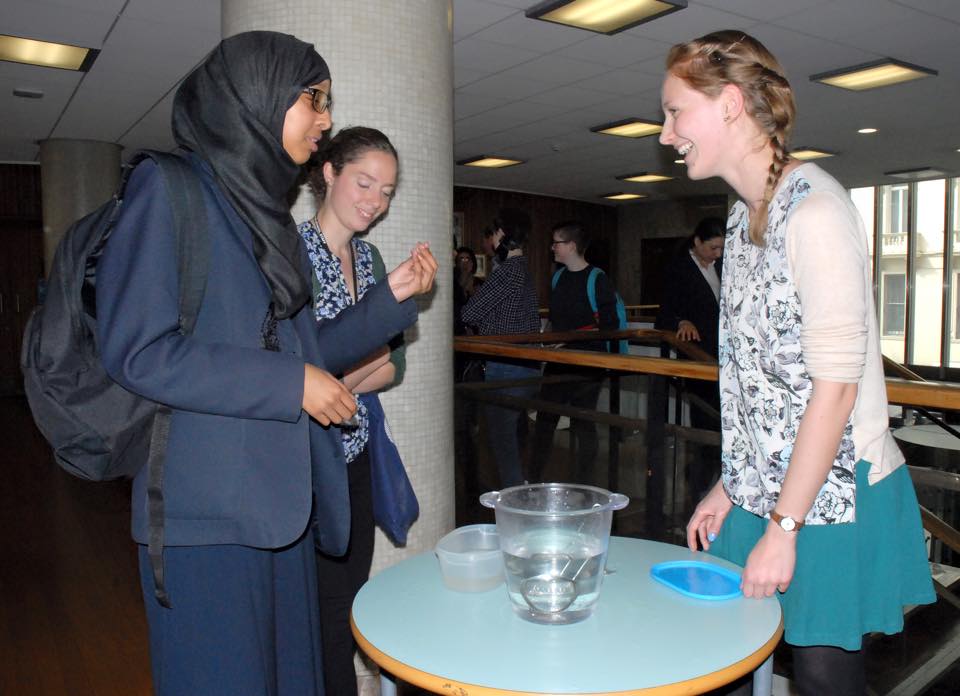
The girls who visited enjoyed science demos including 'invisible' water beads, spectrometers, dancing cornstarch,  making clouds with dry ice and superconductors! I was lucky enough to be a volunteer at the Open Day and managed to demonstrate the dry ice clouds with the fantastic Jess Wade, a PhD student at Imperial College in the EXSS (Experimental Solid State) Group.

Meeting the girls of Lampton School, a local school in my hometown was a nice surprise and most wanted to take Physics onto higher education thus making the day a success with lots of positive feedback!


I was able to help out with making 'a cloud in a bubble'. Here we have an experiment that you can do in schools provided you have some dry ice. Dry ice is solid carbon dioxide at a temperature of -79 °C - much colder than fridge! Dry ice has a special property, at room temperature it sublimes, meaning it skips out the liquid phase and goes straight from solid to gas. We add this dry ice to a bottle of water with a tube attached. When the dry ice encounters the water it sublimes and the carbon dioxide gas travel down the tube and can enter a washing up liquid solution. In here bubbles filled with carbon dioxide are made - and that's how you make a cloud in a bottle! Dry ice is used in films to give that witches' cauldron effect.

Superconductors and magnetic levitation

'Cloud in a bubble'

Jess Wade and dry ice!