Day 1
At 10:30 we had the usual group meeting where everyone in the group got a chance to update everyone with their work. I spoke about the dispersion curves I was in the process of plotting and my supervisor advised me to start putting optics into my setup so that I could characterise them after I had plotted the dispersion curve. So after the meeting I managed to plot the dispersion curve (wavelength against pixel number) and got an approximately straight line. I also plotted marked wavelength (each interference filter had the wavelength marked on it) against the wavelength I measured from the spectrometer and its software. This gave a straight line which showed that the spectrometer was quite well calibrated.
I then had a quick meeting with my supervisor where we discussed the graphs and he said they looked good - which was such a relief because I was having doubts about my work. If there is one piece of advice I would give to someone taking a summer placement it would be ask questions! Ask lots of questions, not only does it help you to learn but it also shows others that you are keen to learn more - your supervisor might be your potential employer so this will definitely give you plus points!
My supervisor then said that I could start characterising optics! He wanted me to measure the light transmitted through the optic at 0 and 45 degrees. So I went into the lab and set up my equipment in the following way:
 |
| Left to right: Spectrometer, optic in question, collimating lens and fibre-based white light source |
 |
| Experimental set-up in the dark |
 |
| Set-up |
 |
| Orange optic |
 |
| The same orange-y optic which has a green-blue tint. |
Firstly, I took a measurement of the spectrum produced by the white light source so that I could use this to compare the spectra produced when the optic was placed in front of the light in order to see how the optic behaved. I took measurements for two optics before I called it a day. The software was pretty easy to use so taking measurements was very easy once I had a little practice.
Day 2
This morning I had a chance to talk to a PhD student about her work and experience at Imperial College. It was great to see that you don't have to be a super-genius to do a PhD which made me feel like I could also do a PhD if I put my mind to it. This gave me some confidence to keep working hard and hopefully one day follow in her footsteps and do a PhD. Another piece of advice I would give to a summer student would be to get to know the person/people you are working with - they have been through everything you have gone through so far and so have the best advice to give you and who knows they may inspire you to follow a career path in something you never imagined yourself doing!
After this, I got back to work on characterising some more optics and managed to get through three more optics. I collected the data from the software onto a USB and then went to my office computer and transferred the data from Excel (which is what the software uses) to OriginLab, a graphing software that I use in my undergraduate studies. From there I quickly realised that not all my data was there :( - so I had to go back and re-take the measurements and again the same thing. I pondered about it for a while and couldn't figure out what was wrong - I went back to the lab and began troubleshooting. Whilst I was collecting data I scrolled down on the Excel spreadsheet as the data was being transferred to Excel and quickly realised that I was saving the data before the programme had time to transfer all the data to the Excel spreadsheet which is why I only got half the data. So tomorrow I shall need to retake all the data.
Day 3
So I took the measurements again for the six optics which had the following appearances:
Optic 1: clear, no tint
Optic 2: slightly green tint
Optic 3: blue with pink tint
Optic 4: orange
Optic 5: green with pink tint
Optic 6: green with purple tint
I also noticed that with optic 3 and 4 there was a change in the wavelength (colour) of the reflected light at different angles, as seen in the following video on my Twitter account here - which was really cool!
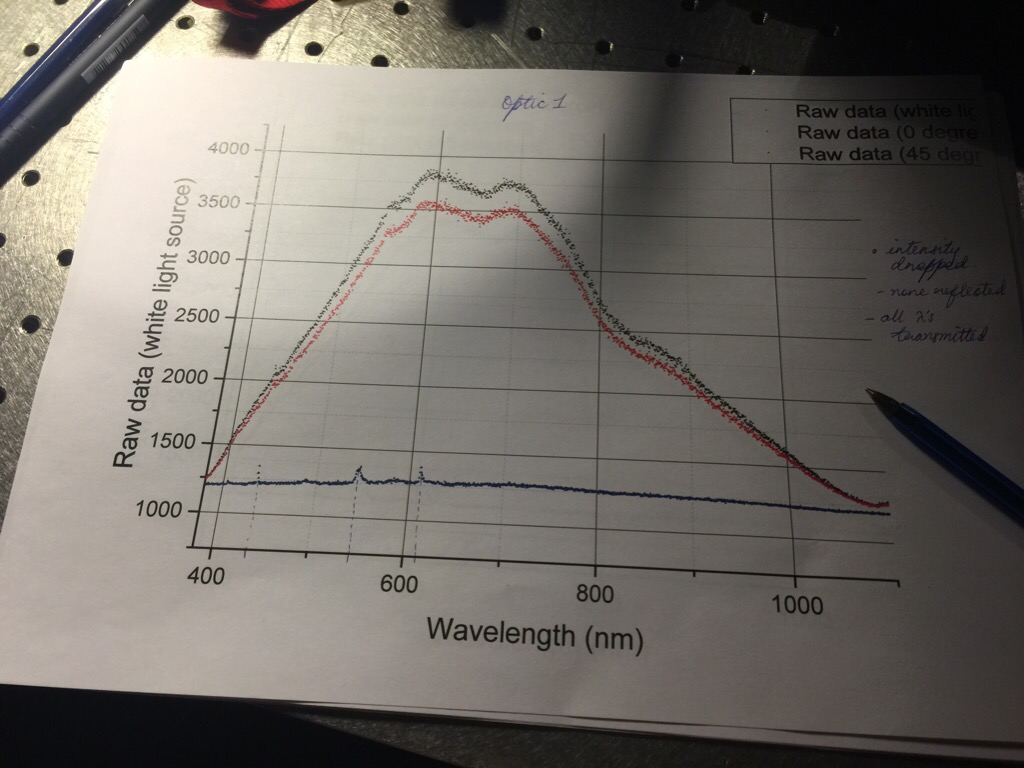
After taking the measurements I plotted the data on OriginLab and got some pretty graphs:
I used the screen reader tool on OriginLab to find out the coordinates of the point of interest, for instance the wavelength at the point where there is not transmittance which I then labelled on the printed graphs. There were points on the graph were I noticed a range of wavelengths were absorbed by a particular optic - it was amazing to see how spectroscopy could tell so much about the optic. I then showed my supervisor the graphs and he liked them! :) I also learned that optics labelled with AR were anti-reflective and HR were highly reflective.
 |
| Top two optics are interference filters and the bottom one is yet to be characterised fully |
After a long day in the lab I attended the PG (postgraduate) BBQ which was the perfect opportunity for me to know the people in my group a lot better - I would definitely recommend any summer students out there to make the most of any socials so that you can learn more about the people you work with and what they do. The food was great and the people were so nice - I had a great time! There was also some music being played and an opportunity for the audience to get up and sing - I don't know what came over me but I got up and sang with an Outreach Officer that I knew, was a laugh!
Day 4
Today I went all out in the lab and got through 22 optics! Before I met my supervisor at 5 pm I got a chance to witness some cool science! I witnessed the dissection of a cockroach and a fly! I did not expect this in a laser lab! But once they explained what they were doing I understood why they were dissecting them! Turns out they were doing some x-ray imaging - where the x-rays were by-products of a laser-plasma interaction. This was so cool and right up my street, since the reason I took physics in the first place was because I was fascinated by medical imaging.
I then met up with my supervisor in the lab and he checked my method of measurement and it was fine. He then offered some improvements which included an iris which essentially just blocks some of my white light source so that I can have a nice clean beam without any chromatic aberration which was seen near the outer edges of the light beam. Chromatic aberration is where a lens fails to focus or in my case collimate all the wavelengths (colours) to the same place. He also suggested that I use a polariser so that I could check whether any of the optics I was characterising were polarisers - but this decreased the intensity of my light source so he recommended that I use a focusing lens to increase the intensity of my signal so that I could capture it on the spectrometer. We went into the lab upstairs to get these items so that I could make these improvements tomorrow.
 |
| Polariser |
 |
| Iris |
Day 5
As soon as I got in I went straight into the lab and got to work on making the improvements. I had to get new posts and post-holders for the new items I was going to add to my set-up. My supervisor also wanted me to use up more of my bench space so I took all the apparatus apart and put them into their new positions. I then added the iris and the focusing lens to my set-up. This took a bit of time because I had to collimate the white light source again and put the focusing lens in the correct position for optimum results.
 |
| Changing my set-up - unscrewing the equipment |
 |
| New set-up |
After lunch I caught up with those that were doing the x-ray imaging yesterday and they had the coolest image of a fly wing that I've ever seen been taken in a university laboratory! It made my mouth drop! At that moment I wanted their job!
Since one of the postdocs was leaving we had another social which was another great opportunity to get to know the people in the Plasma Group.
I am taking a break from my summer placement for a month but I shall return in September and more blog posts will come then. For now I shall say, why not try a summer placement, learn new things and have something great to talk about in an interview! Have a great summer! :)