Saturday, 28 March 2015

Science Challenge: Imperial College


Back in January I decided to enter the Science Challenge, which is 'the Royal College of Science Union's annual science communication competition. Requiring entrants to demonstrate their skills in scientific debate and reasoning, the Science Challenge tests the ability of today's young scientists to teach the public about the science that affects their lives.'
Not only can Imperial students enter but schools can too! So why not enter next year! Communicate your enthusiasm for Science and if you're lucky you may even be rewarded for it - previous years have had trips to CERN! Make sure you don't miss out!

Although I didn't get into the finals, I managed to get to the quarter-finals with the following essay: 

"How do we get the next generation interested in STEM (Science, Technology, Engineering, Medicine)?" Answer this question via an essay, maximum 800 words.

The next generation are the future so in order to get them interested in STEM we must get them while they are young. Let’s just take a look at what is in toy stores. In the girls aisle we see a blur of different shades of pink, we focus onto the items and we begin to see tutus and dolls. On the other hand the boys’ aisle is a blur of blue which turns out to be construction toys which help develop their skills, like logic, problem solving and creative thinking. Shouldn't girls be able to play with such skill-enriching toys? If we are going to try and get the next generation interested in STEM this is the place to start.

Taking the young to planetariums, hands-on workshops and live events to see science in front of their eyes is a great way to stimulate their interest but the key thing here is maintaining that interest. As they grow they may start to outgrow the ‘family outings’ and begin to wander into the Universe on their own – how do we keep them interested in STEM? We tell them that STEM needs them, that they are a young, curious mind that could help unravel the mysteries of our cosmos. One major way we can do this is by getting them involved with real science. Whether that is participating in identifying cancer cells, counting birds or controlling an experiment online they can see and do real science at their fingertips. Make STEM something that can be done at home – using everyday objects to uncover the delightful surprises that STEM has to offer. Science shows like The Royal Institution Christmas lectures where the whole family can get involved and do science at home should be something that we see more on TV.

So we can try and get the young ones but what’s to stop the parents from telling them that STEM is too hard or what can you possibly do with STEM? We need to educate the parents and let them know about the myriad of opportunities available to their children via STEM. This can be done by advertising – having little fact files about, say, how much the engineer who helped design a building earns, what they do and what degree is required which could be displayed somewhere on the building or in the vicinity. Even larger advertising endeavours could include bus shelters, billboards and public transport where posters about job profiles displayed in a modern way through artistic means could be put up. Even just cool STEM facts or STEM teasers to grab a reader to learn more through a link that may be displayed on the poster to engage the public, including the next generation into STEM.

But let’s take a step into the classroom. This is where those young minds first encounter STEM via academic means and this is where they decide if they want to take STEM further. Classrooms sometimes lack enthusiastic teachers, stimulating demonstrations and real STEMists (a scientist, technologist, engineer or medic). Now, of course we cannot make it compulsory for teachers to be enthusiastic but we can bring real STEMists in. Where the STEMist should not throw facts at the students but should instead spark their interest, whether this is via a hands-on experiment, a group project or through trips to real laboratories, observatories and other STEM landmarks that would get them engaged in STEM. The students need to be able to see that STEM has a purpose in their life and that with STEM they can truly change the world - they are the ones that shall sculpt the future.

In particular, a STEMist who was an ex-student of the school would have a larger impact on the students as they used to sit in the same classroom seats as the current students. They can relate to them on a different level and truly believe that they have the capability to follow in their footsteps and be successful in STEM. More importantly, bringing undergraduates who were also ex-students into the school could relate to the students even more as they are roughly the same age and they can share their experiences and knowledge about the wonders of STEM.

All in all, STEM needs to be approachable and the stereotype of STEM being hard and boring needs to be eradicated via interaction with the next generation through the methods aforementioned; hopefully this is the way forward for a STEM rich future!


Saturday, 14 March 2015

Women in Physics Imperial College


Women physicists at Imperial College now have a new community, from undergraduate to Professor-level, where they can support and encourage other females to remain in physics. 

Courtesy of Jess Wade, a PhD student currently in her final year at Imperial College, two Women in Physics events were held this week at Imperial College in celebration of International Women's Day: a postgraduate and undergraduate lunch.

We had a great turnout and I even got a chance to speak to the postgraduates and undergraduates at the lunches explaining how WiP (Women in Physics) could help undergraduates like myself. It was great to see so many female physicists at Imperial - something that I don't see in lectures, labs or tutorials.

There are so many schemes out there for secondary students to take Physics but once at university I felt there was no encouragement or inspiration for females to remain in Physics and there was no connection between the years. But now with WiP we hope the future will be bright and more females shall have a longer Physics path!

Here are a few pictures from the postgraduate and undergraduate lunch:

Postgraduate Lunch

Spreading my thoughts about how postgraduates can help undergraduates along their Physics path by acting as female role models

Professor Michelle Dougherty, Principle Investigator of Cassini-Huygens Mission


Jess Wade, the magic behind WiP!


Professor Lesley Cohen (Solid State) and Professor Fay Dowker (Theoretical Physics)


Undergraduate lunch

Jess spreading the love for WiP!


Great turnout!

Spreading the word about how WiP can help undergraduates.


Lovely WiP cupcakes by Jess!

Getting ideas for the future of WiP

More idea collecting


Lovely to see group chats


All in all, it was a brilliant launch for WiP and we received great feedback with many wanting more WiP events!
 

Sunday, 1 February 2015

Electrostatic Slime - Science you can do at home!


See how a balloon can stop a substance from being poured with just a balloon, cornstarch and vegetable oil! All things that you can find at home, so go on grab some vegetable oil and cornstarch from the cupboard and a balloon from your last birthday party (or make a quick trip to your nearest supermarket) and get ready for some sciency fun!

Mix equal amounts of vegetable oil and cornstarch powder into a cup - so if you put a quarter of a cup of vegetable oil then you need a quarter of a cup of cornstarch powder added to this. Then stir with a spoon and that's it! You've made your electrostatic slime!

Now grab that party balloon and rub it in your hair or a woolly jumper - you've now charged the balloon (more science talk is on its way). Now start to pour your slime into another cup and then bring the balloon near the slime and watch it get attracted towards the balloon and you may even see it stop pouring! 

Here's some successful electrostatic slime:


Slimey Science

When you rub the balloon in your hair or against your woolly jumper electrons from your hair/jumper are rubbed off onto the balloon by friction. Thus, the balloon gains a negative charge and your hair becomes positively charged and you know that like charges repel and opposite charges attract - this is why your hair suddenly becomes attracted to the balloon! 

But how does the slime get attracted to the balloon without touching it?! Well, what we have made is a substance where the solid cornstarch particles are 'swimming' in the vegetable oil and in the presence of an electric field - the region around a charged object (the balloon in this case), the viscosity or how runny the substance is changes. Near the balloon the substance becomes less runny and this is what makes it stop pouring - in sciency terms the slime is called a electrorheological liquid (people will think you are a super genius with that term!) 
These types of fluids are used in some brakes where a 'voltage' is applied to change the runny-ness of the fluid.  

But in greater detail we know that atoms contain electrons and so the negative charge of the balloon pushes the electrons in the 'cornstarch atoms' away and then we get a 'net' positive charge of the slime on the side closest to the balloon and so the slime moves towards the balloon due to what is called 'electrostatic' attraction,  as shown below:


Get making and spread some science!

Sunday, 25 January 2015

Jasmin Nitu, finalist

I had the honour of working with Jasmin Nitu, a year 9 student of Heston Community School (my old secondary school) where I gave her a few tips on how to deal with the grueling judging process that she was going to face at the finals of the National Competition that involved writing an essay titled Why I love science? which was held at Rutherford Appleton Laboratory (RAL).


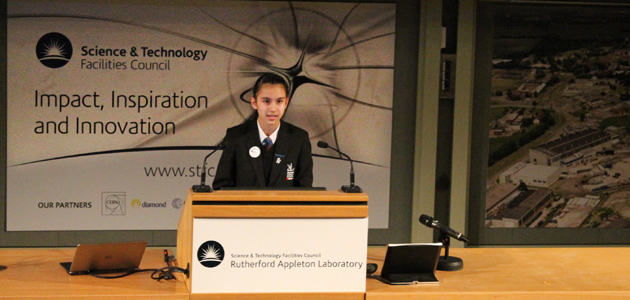
Her sheer enthusiasm for making a change to the world with science shone through her essay which led her to present her work at the Rutherford Appleton Laboratory alongside 15 other finalists. Here is an excerpt of her essay:

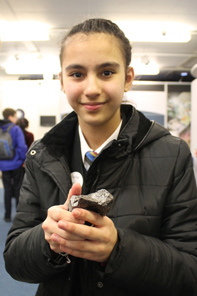
 Jasmin with meteorite“When I started secondary school, we had the opportunity to undertake more experiments such as chemical reactions and energy. First came energy, where we had to understand different types of energy. This was a fun experience as I learnt about the different types of energy. Next were chemical reactions, which is my favourite part in science. We did experiments such as testing for oxygen, carbon dioxide and hydrogen. We also did mixtures of acids and the PH scale. This was an exciting thing to discover as I always wanted to play with acids and see what different things I can do with them. As you can probably figure out my favourite topic is chemistry.”
“Next comes the crucial year, year 9. Now that I have found out that science can change the world, we all should contribute to research such as pollution, recycling, medication, plants and water resources. We should all start thinking about the fact that global warming is happening such as melting glaciers, nuclear powers, cutting trees, wasting water and erupting volcanoes. We could all help in some way by donating and supporting science.

As a conclusion I love science because science can change the world in all aspects.”

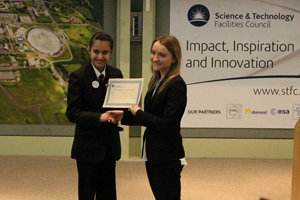
Her efforts were rewarded with a certificate from a leading scientist at RAL. 

Jasmin presenting at RAL


 Jasmin receives her certificate


It is young, curious minds like Jasmin's that push us to be the best that we can be. Here is some evidence that no matter your age, ethnicity, or background you can still achieve - just believe in yourself and you shall be pleasantly surprised. You can achieve anything you put your mind to, so go on do something amazing today!


Now for some cool scientific facts about RAL!


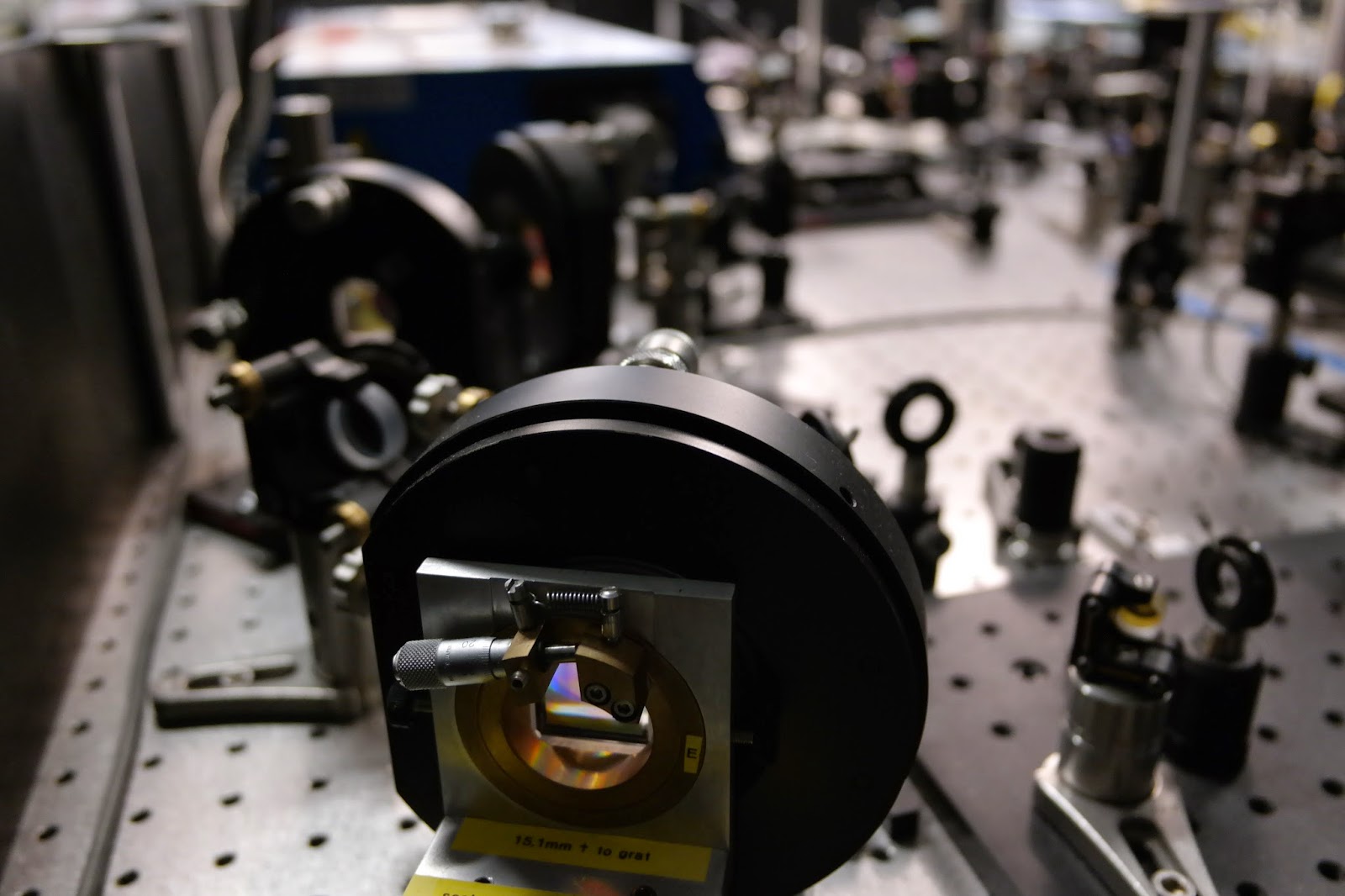
  • It houses one of the world's leading laser facilities with lasers that can recreate the conditions inside the fireballs of nature, stars!

  • It was named after the discoverer of the nucleus and hence the modern picture of the atom, Lord Ernest Rutherford

  • RAL Space has been involved with more than 200 international space missions, including Herschel, the largest space telescope ever launched! - it examines the early stages of star birth and galaxy formation. 


Sunday, 4 January 2015

My summer as a young-researcher

After a grueling interview process at the end of the first year of my Physics undergraduate studies at Imperial College, I was given the unique opportunity to become a young researcher for eight weeks over the summer in the Plasma Physics Department at Imperial College.

My work involved helping to build something that can accelerate charged particles, like electrons that make up me and you. It was called a Wakefield accelerator and it could fit on your coffee table!
Here is what the vacuum chamber for the wakefield accelerator looked like:


Vacuum chamber that I built with Dr. Christos Kamperidis of the Plasma Physics Department at Imperial College


But like you, I had no idea what this object was, what it could do or what it was useful for - as far as I was concerned it was just a metal cube! I shall try and explain how a Wakefield accelerator works in simple terms later in this blog.

But first let me tell you about my experience in the research group - day 1.
When I was introduced to the staff in the Plasma Group I wasn't surprised to find that there was only one female in the Group. So I felt quite alone and a bit uncomfortable having all these male brains in the room. I certainly felt the initial judgement that I wasn't clever enough for the Group or so I felt... I was introduced to the project I was going to be working on and immediately I was overwhelmed by the information! I didn't even know what a plasma was let alone what plasma acceleration was! But after a day or two of solid research I quickly grasped the information and I was able to understand what on earth the Plasma Physics Group were on about! I surprised my supervisor with my knowledge and that made me feel on top of the world because I broke the stereotype of females being too 'dumb' for Physics. Day 5 and I was ready to show all those male brains in the Group meeting that I could do as well as the boys. Luckily all my hard work that week paid off and they didn't think I was stupid, I felt a part of the team and that my input was valued.

By the third week I was getting into the nitty gritty parts of my project and I started to build the vacuum chamber that would house the plasma. Before I continue, as I mentioned earlier I shall try and explain what Wakefield acceleration is using simple terms. 

Wakefield acceleration is a form of acceleration of charged particles using a plasma. Plasma is the fourth state of matter. Think about some ice (a solid) you have in the freezer, if you take it out the warmth of your surrounding makes the ice melt into water (a liquid) then if you put the water in the kettle for your cup of tea some of it evaporates into steam (a gas), and if we were to heat this steam then we would get a plasma.
Illustrates the four states of matter


A plasma is a substance that has been heated to the point where atoms can’t hold themselves together and so exist as a soup of electrons and ions. To see how it works, let’s consider a bunch of electrons are injected into a plasma, which as aforementioned is a soup of ions and electrons. 

Due to the injection of the electron bunch, electrons in its path will be repelled and positive ions will be attracted. As the electron bunch passes through the plasma it leaves a wake much like the waves that a boat leaves as it travels through water. A channel of positive ions is formed and the electrons are repelled and move towards the back of the electron beam towards the positive ions also repelling the electron bunch causing the electron bunch to accelerate. This process continues until it reaches a maximum speed. 

Illustrates plasma (Wakefield) acceleration

As an analogy plasma acceleration is a lot like surfing. Imagine a boat with its bow (front part of boat) tilted upwards speeding through the water and a huge wake ripples behind it. A surfer could take a free ride on these ripples just like the electron bunch mentioned earlier ‘surfing’ its own wake and gaining energy. The boat that initiates the wake can either be an electron or proton bunch or a laser beam. The lake can be considered to be the plasma. 

My project involved using a laser as the boat to drive the acceleration and create the wake. But for efficient acceleration this needs to be done in a vacuum chamber. So the vacuum chamber pictured above was built and connected to a vacuum pump - it reached a vacuum that was even better than the vacuum of outer space!

The vacuum of the chamber measured in the units, millibar. 

Part of my project was to also design the shape of a gas nozzle for the nitrogen gas that would enter the vacuum chamber . The nitrogen gas shall form the plasma we need when the high energy laser pulse causes the nitrogen to lose electrons, a process known as ionisation. 
The design for the gas nozzle was done using a computer program called OpenFOAM. I only had eight weeks to familiarise myself with the program and since I had little computing experience this was quite a tedious process but I managed to get this far:

Shows the flow of nitrogen gas (bottom) into a vacuum chamber (box above).
This was a huge achievement for me since I didn't even know what computing was nine months before the placement. I introduced the head of the Group to the Raspberry Pi, a mini computer and managed to hook up three webcams to it and create live streams using the local network which would later be used to monitor different parts of a laser system from another computer connected to the local network which could be ten floors up! 


The Raspberry Pi, a mini computer

I would definitely recommend a Raspberry Pi to anyone, no matter your age - it can be great fun and you'll learn about the wonderful things you can do with code too!

In addition to this, I got to design a gas nozzle using CAD software, where CAD stands for Computer Aided Design - so I used a software called AutoCAD where I used shapes within the software to make the desired nozzle shape and here it is:


When converted into the correct file format this could be sent to a 3D printer and then 3D printed into reality!  

As an added bonus, I was very privileged to be able to see the laser facility being built at Imperial College - right beneath the lecture I sit in! I shadowed Dr. Christos Kamperidis and Katalin Mecseki, two wonderful postdocs that were kind enough to let me see them working with a rather cool laser system!


As the cherry on top I was able to visit the huge laser system, Gemini, at the Rutherford Appleton Laboratory's Central Laser Facility in Didcot, Oxfordshire. The laser facility was huge and by far the largest piece of equipment I have ever seen!


You can just about make out the clean suit I had to put on when I was viewing the laser system, Gemini.

I also took a chance to have a look around Rutherford Appleton Laboratory (RAL) - for any teachers out there reading this you can take your students to RAL, check this out:


The atom tree

The atom tree at RAL


An unused control room - the room next door to the active control room I visited
Posters decorate the area, recently put up.


The above reminded me of a school trip with my inspirational Physics teacher when I was in year 12 back in 2012! This moment changed my life, this trip showed me the applications of Physics in Medicine and completely changed my view on the subject - I could change lives with Physics!
School trip back in 2012!


I certainly didn't think I would contribute so much to the Group - it was an experience that shall stay with me forever. I was able to fit into a male-dominated Group and contribute too! So for all you, young scientists out there, especially the girls, don't ever think you are not good enough because I am sure you will be pleasantly surprised when you step outside your comfort zone and try something new! I've mentioned this saying in a previous post but I think it deserves a mention here: 

'You are all stars you just have to initiate that fusion!'.

Although physics might seem like a male subject, we girls can do as well as the boys (if not better!) if we put our mind to it. There are so many females out there discovering great things and you can do it too! Why not email a real scientist and find out about the work they are doing, take part in a science workshop, go to a public science lecture or take part in science projects; whatever it may be get involved with science and maybe you'll catch the science bug!